Friday, 5 August 2016

Try a little tenderness

It's time for the Olympics, and unfortunately there's a popular sport with no qualification required to participate or limit on who can. It's open season year round, and anybody can jump in anytime.

Sound like fun?

Well, it's Breeder Bashing.

I have no idea if cat breeders - or gerbils, or exotic reptiles, or potbellied pigs - are subject to the same near incessant barrage of hate speech, slander, public ridicule, advertising campaigns, and manipulation of public opinion as dog breeders. Part of me hopes not - way too much hate in the air - and part of me hopes so; you know, more the merrier and all that. 

We're people. We have feelings. We're human. 

We aren't perfect. We're not evil. We're not greedy. We're not thoughtless, hateful, scumsucking liars and shitbags. We don't sit around spending our time trying to figure out how to produce dogs with faults, or health problems, coming up with new and creative ways to fuck up. We really don't.

And anyone that suggests otherwise is lying.

I have a puppy buyer (doesn't own a computer, so she'll never see this) who calls roughly once a month. Usually it's all about how happy she is with her dogs, how beautiful they are, what great temperaments they have, how much their groomers love them, how good they are at the vet's office... and at some point, without fail, she'll say "You know, Fluffy is missing a tooth."

Yes, I know. You've told me once a month for the past year.

No, I don't say that out loud; I just bite my tongue. Yes, I know. So is her sister, my pick bitch. It's unfortunate, but it's not a DQ, and one premolar isn't going to affect her show career, hunting ability, or quality of life.

Here's the thing: There is no way on god's green earth I could deliberately produce a dog missing one tooth; I wouldn't know how to do it. Particularly not when I'm bending over backwards to do the exact opposite. 

Both parents had full dentition. The sire's dam is missing one tooth so we spent a LOT of time looking for a bitch strong for full mouths. The dam is from a litter of full mouths with both parents having full dentition. On the long, long, long list of things Mother Nature has a knack for being unpredictable with, dentition is a doozy. And don't get me started on bites (scissors, level, anterior and posterior crossbites, popped bites, undershot, parrot mouth...), recent data found roughly 30 separate genes control jaws/bites and dentition in dogs. It's something of a miracle perfect mouths are ever produced!

People want guarantees, even though we are dealing with living organisms. They want the impossible.

We do the best we can, we really do. We accept, grudgingly, that no matter how hard we try, we're still going to get screwed. Because that's how Mother Nature works.

Let's look at my breed, at borzoi, and what health testing is considered routine. 

There's degenerative myelopathy, and we have a great DNA test for that. What we don't have is a good understanding of penetrance - why some At Risk dogs never develop the disease and others do. (A recent break-through in corgis holds proffers answers --- but --- what is true in one breed doesn't always apply to other breeds.)

There's a great lab test for autoimmune thyroiditis, but all it can do is identify affected animals. And a dog that is Normal at 2 years may be affected at 5, or 7. So repeating the test, again and again, over an animal's lifetime is more accurate than a single test. And it's an expensive test - not the test itself, but shipping blood overnight. We assume all offspring of an affected dog are carriers, so we can identify carriers (and not breed a carrier to another carrier, thus not knowingly producing dogs that will be affected) - but we can only do this if the test results are in the public database.

Those two tests are pretty bullet-proof. They are lab tests with controlled references run on finely tuned and very expensive machines, with built-in redundancies to verify abnormal results before owners are contacted. DM is a "one and done" test because it's DNA based. Thyroid should be repeated every couple of years to detect later-onset. 

The remaining tests available to us are important, but generally not as black and white when it comes to execution.  

There's a great testing procedure for eyes, and such testing is pretty easy to get and widely available and generally very affordable -- other than it's an annual exam. Commonly known as a CERF exam (though technically it's an CAER exam), this is performed by a veterinary ophthalmologist (AVCO), it can identify congenital problems in puppies under 12 weeks of age (e.g., coloboma), separate acquired problems from genetic ones (e.g., FMAR), and track the progression of problems (macular degeneration, developmental corneal opacity, PPM - the list is long). It's another one of those tests that should be performed multiple times over the course of a dog's lifetime, because some heritable problems are detectable in young dogs (e.g., lens luxation) and others don't present until a dog is an adult or even a senior animal (e.g., catarats). As you can see (no pun actually intended), eyes are complex. Getting perfect eyes is hard, but vision is essential to both quality of life and function, so we try.

Then there's hearts. There are three different cardiac exams, and breeds have varying expectations about testing based on the type and frequency of problems known to exist. Auscultation (listening) can be done by a regular clinician, specialist, or a cardiologist. Depending on the quality of the stethoscope and the expertise of the vet, this is generally viewed as being of limited value; there are just too many variables. Holter exams are useful for finding chronic arrhythmias, but unreliable for intermittent ones and useless for an acute arrhythmia (which can kill a dog with no warning - ruefully referred to as Dead Dog Syndrome because the first symptom is, well, the dog is dead). Holter exams are standard in some breeds (Boxers and Dobermans, among others) and require shaving off the coat so the leads can be attached to the skin. Results can be interpreted by a specialist or a cardiologist, and the accuracy of that interpretation depends on the skill, experience, and training of the person reading the data. Echocardiograms are generally considered the gold standard for a heart exam, and can be performed by either a specialist or a cardiologist. Sometimes the hair has to be shaved off a large area of the chest to get really accurate views, and (like auscultations) the quality of the equipment and skill of the user are factors in the accuracy of the information gathered. A standard echo may only get three chambers of the heart; all four chambers and all four valves are desired, but sometimes the weight of the dog or the temperament or the equipment or the skill of the technician limit the views. Sometimes color dopper is used, and it may reveal additional information which has no known clinical significance. One of the most frustrating things about hearts is the range of findings can go from "perfect" to "OMG awful" -- but most of the time it's somewhere in the middle - normal but not perfect; not normal but acquired not congenital or heritable; not normal and genetic in some way; and on and on.

I have first hand knowledge of a bitch that was diagnosed (dx) with a heart murmur at age 6. Because it was found by auscultation, an echo was recommended. The echo found the heart murmur was acquired (age related) and not heritable. Had the owner not done the echo, they would have had incomplete information. I have first hand knowledge of a dog with a similar finding at age 4; echo found evidence of infection had damaged a valve in the heart. A finding on auscultation is incomplete at best, and misleading at worst.

Then there's osteosarcoma and GDV; neither of which has any test but time and plagues every line in some way. We do the best we can to identify problems, and breed away from them (either by not breeding affected animals, or breeding to lines that don't also have the same problem). 

Dogs aren't perfect. People aren't perfect. We don't have perfect tests for everything. We're doing the best we can, we really are.

Yes, your bitch is missing a tooth. I'm really sorry about that, I'm doing the best I can.

And the breeder bashers are on constant standby, ready to blame. The peanut gallery is always primed to say oh you shoulda, you coulda. And somebody who's never bred a litter, much less several, who's never agonized over what to do, or not do, or how to make something right, has never cried a million tears when it all goes to hell despite every effort to do everything right... Well the peanut gallery is just wrong. And mean. And hurtful. Anybody can stand on the sidelines and run their mouth in judgment or pretend they have 20/20 hindsight. They all need to fuck off because they do not know what they are talking about. 

So, why spend all this money and effort and heartache on testing? Why indeed.

Because we believe it's the right thing to do. Because not testing, or not sharing results, is a type of lie. Because doing everything we know how to do to prevent problems makes it easier to sleep at night. And when we, inevitably, get screwed by Mother Nature anyway, we have our friends with the same values and ethics to share the tears.

Yes, your bitch is missing a tooth. I'm really sorry about that, I'm doing the best I can.

People want guarantees, I get that. Uncertainty is hard. But we are dealing with living organisms. We all want the impossible, we all want perfection. The ethical among us won't talk in absolutes, but will tell the ugly, messy, and unhappy truth. And when honest breeders won't lie or give guarantees of the impossible, some people will go and buy a lie from someone else. 

So, let's be kind to one another, and supportive of best efforts, and be a shoulder to cry on for each other, and not be party to the whispering or finger pointing. Let's ask tough questions, and give honest answers, and be understanding of the inherently imperfect nature of Mother Nature. Let's try a little tenderness.

Monday, 23 February 2015

Time to Stop the Madness

I try very hard not to let my buttons get pushed. But sometimes, it happens. I see it coming, and say, yeah, go ahead: push it.

Things started out innocently enough. Victoria Stilwell (of BBC's It's me or the Dog fame) posted on her blog a link to an article written by Sophia Yin DVM, MS - a giant in the world of veterinary behavior.

Dr. Yin has published several books and articles, and was a brilliant public speaker. Her untimely passing last year was an incalculable loss for dog owners and dogs alike.

Sophia had serious cred, and made important information accessible to everyone. Victoria started out as an actress, and has done tremendous good for the field of dog training via tv (way more that that other guy).

I posted, perhaps foolishly, perhaps provocatively, in response to Victoria's posting of Sophia's article:


The point of the article, is, on the face of it, one that most people agree with. In fact, I find it pretty easy to agree with most of it. A lot of things can go wrong in breeding domestic animals; it's not all sunshine and roses and puppy breath. Mother nature is a wicked bitch, and things go wrong. Entire volumes have been written about the myriad things that can go wrong and how to try to prevent them, and what to try when it all goes to hell anyway. The financial and emotional costs should give pause to all but the most dedicated breeder. (sidebar: #5 of this post should should be a tattoo.) Statistically, most people "get out" of dogs in about five years (I've seen this several places over the years, but can't find a link at the moment. Readers - help me out?).

It's hard work. It can force gut-wrenching, soul-searching choices. And the good days, few and far between as they sometimes are, are a reward full of intangibles that are impossible to quantify.

Which is why we refer to ourselves as a bit dog-crazy... You have to be a bit touched in the head to do it.

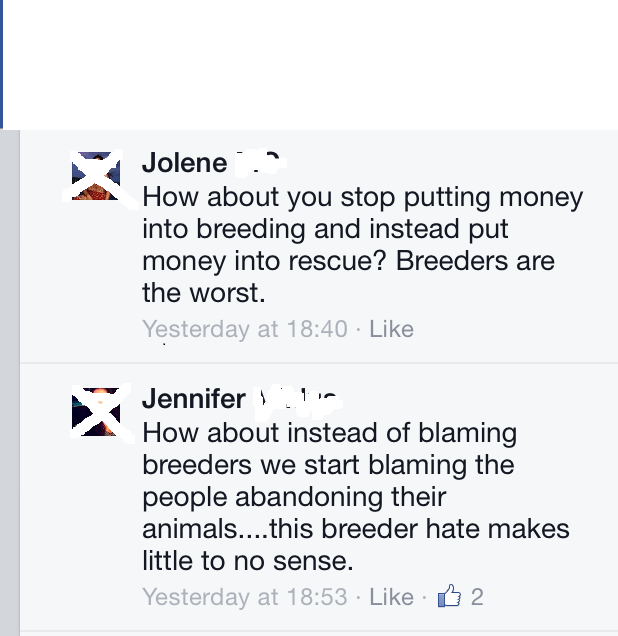
Predictably, the haters started:


and - cue the GSD card:


Ah yes, the predictable, one-size-fits-all, "always" and "never" and holier-than-thou misinformation.

tip: the vocabulary of absolutes is the language of extremists. real life is full of nuance, of sometimes and maybe.


Wait - what? Misinformation?

Well, yes. The problem with propaganda is, it's not accurate. The haters are furiously clinging to ignorance because they don't want to deal with the facts.
   Oh, if only we had to "force" our dogs to breed. Anybody that has ever had crates, doors, and walls destroyed by two dogs determined to get to each other - or, conversely, had a bitch say over his dead body to a male's advances - knows what a ludicrous fallacy that is.

What facts?

These facts: Why dogs are in shelters. Where shelter dogs come from. What's changing with shelter populations. The trends in dog flipping. The reality that this is a demand problem. The reality that it's actually smart money to get a dog from a responsible breeder. The fact that it's pretty easy to tell a good breeder from a bad one - all you have to do is make an effort. The fact that there are NO DATA that support the urban legend of random-bred dogs being healthier than purpose bred dogs; the data in fact show that mixed breeds are LESS healthy. Read Hutchinson. Peruse OFA. The facts are there.

One pet peeve - it ain't adoption. Money changes hands. It's a purchase. The difference is, where did you buy the dog?

Read the last sentence in the bottom comment. Read it again. I do wonder what the rest of the story is on that...

My favorite comment - sorry, I can't find it now - was someone suggesting (tongue in cheek) that people stop having babies as long as there are children in foster care. Now there's an ironic analogy that would give one pause.


Many people posted their agreement (50+ "likes" is a lot), and their own comments. It's nice not to be the only voice of reason in the dark.


And this:


Name another hobby where people feel comfortable verbally assaulting total strangers and telling them how to spend their money. I bet knitters don't get this sort of vitriol. Model horse enthusiasts. Remote controlled gliders. College football fans. Shriners. Collectors of stamps, coins, rocks, fine art, guns, books, jazz... No? Can't think of one? Me either.

And, really, that's what this is - hate. Plain and simple. Hate usually stems from fear, which often comes from ignorance.

I have always said - ignorance is curable. Stupidity... not so much.

Jon Katz said it well:
As always, it is the dogs who suffer from this human arrogance, not the people. Dog bites on children are epidemic, millions of dogs are returned to shelters and rescue facilities each year because people get them without knowing anything about them or how to live with them.
 Sometimes it seems that the whole point of getting a dog for many people – this is quite clear from my messages –  is to rescue something, to feel good. The messengers have no ideas about getting a dog other than that it must be rescued. As if that is enough to know.
You can read the entire essay here.

Time to stop willful ignorance, the hate. Time to look at the DATA, not the propaganda. Time to deal with reality.

Tuesday, 20 January 2015

Familiar Stranger

This past weekend, while sharing a hotel room with dear friends, I said aloud something that has been bugging me for at least a year.

Now I understand why people dye their hair and have plastic surgery. The face in the mirror every morning doesn't match the picture of myself in my head.

Or, put more bluntly:

Who the hell is that old hag? And why is she looking at me with knowing eyes?

I can honestly say I earned every wrinkle and grey hair. I wouldn't go back to my 20's for anything, and I mean, not for nothing. I learned a lot in my 30's, hit my stride in my 40's. Now, in my 50's, I acknowledge that I've probably got more years behind me than ahead. Hopefully I'm just now at the half-way point, as it would be a pity I think to waste all the learning - is this wisdom? - by not having as much time to use it as I spent acquiring it.

I have never been particularly vain, so it is uncomfortable to feel a jolt every morning in the bathroom mirror - that's me? Well yes, of course it is. Lift the chin and smile a little, and the reflection is more comfortable. Less... well, less old.

It does not help that my husband, a decade older than I, still has the skin of a baby and gets carded at least once a year. Yes, it's typically at a sporting event and while wearing a baseball cap, but still... He is ageless, inside and out. I married Peter Pan.

So I wonder if I should consider getting my hair dyed... no, I would never spend that much money getting my hair done once a month. What a colossal waste of time - I can barely be bothered to get it cut more than three times a year. It is farce to think I would spend my weekends with coloring bottles and wearing a plastic cape. My mother has dyed her hair since she was 16, when it came in winter-white, I know what is involved. I would not pay for botox or a facelift.

I just wonder why I don't look like I feel.

Maybe it's the high desert - too much sun, not enough humidity. Maybe it's the mileage I've put on this body. Maybe it's the mis-spent youth, the abused metabolism, the years of diet Pepsi and Cheetos (breakfast of champions!) Maybe it's taking for granted the gifts of DNA - good bones, good skin, good weight - for a lot of years.

Choices have consequences. And they are staring me in the face, every day.


Wednesday, 7 January 2015

New Year and Resolve

It's 2015. How did that happen? *Pouf* another year gone. It's true - the older I get, the faster the pages turn.

2014 was, on the whole, a pretty good year. There were some tough losses (RIP Jake & Boomer), some very bad days. More of those to come, no doubt. Good days come come at a price, and we paid in spades last year.

It was the first year I made a new year's resolution and really made a regular, conscious effort, to keep to it. I'm pretty pleased with how that turned out. 

So this year, I'm going to try it again. A resolution more public and easy to quantify. Write a blog post at least twice a month.

And yes, this counts as one ;-)

Monday, 22 September 2014

Perception is Reality

Flying back from Texas this weekend, I had an enlightening and disturbing conversation with a seatmate.

Enlightening in that how breeders are (sometimes? frequently? always?) percieved by rescue groups; and disturbing in that, well, her view was utterly toxic.

After a little "hi, whatcha reading" chit-chat, she mentioned that she volunteers with a local breed rescue group - and that she hates breeders. Hm, I said. I'm a breeder.

Awkward silence.

She's involved with a very popular breed, and no doubt sees more dogs in a year locally than I do borzoi at Nationals. But, still...

As we chatted over the next hour, we traded stories, the way strangers do when looking for common ground. She told me a sad story about a friend who paid a fortune for a puppy from a breeder and wound up with a health problem - must be a terrible breeder, she said. Well, I said, maybe. But sometimes we do all the health testing available, generation after generation, and mother nature will take you out for a spin. I told her about Bruno, and showed her the OFA database listing his ancestors' clearances - she didn't know such a thing even existed! 

She told me about her daughter's new SUV, and how they go on home visits together. Ah! I said. Yes, I require that too. And told her about a buyer that didn't get a dog from me due to inadequate fencing and an unwillingness to improve his fence.

Wow, she said. I didn't think breeders cared where their puppies went. They just want to make money.

::speechless::  I mean - really, how does one respond to that? I know it wasn't intended as an insult... It's just her perception - her reality - based on what she sees in rescue.

Well, I said, you may not believe this, but I know, right now, at this very instant, where EVERY puppy ever born in my house is. Right now. 

She looked shocked. 

And, yes, I charge for my puppies. Does your rescue group charge for the dogs you place?

She squirmed. Yes, she said, there's an adoption fee - but, she hastened to add, we lose money on every dog.

Me too, I said. Calling it an adoption fee is just marketing, I smiled. You sell dogs, I sell dogs. And we're all losing money. I haven't figured out how to make a profit. I've easily got five figures invested, once you factor the health testing on the parents, and on the puppies, and the costs of a few years campaigning before doing a breeding. Forget initial purchase price, food, and regular vet care. I lose a fortune on every litter. But - money changes hands - it's a sale.

I also told her how every good breeder I know is also involved in breed rescue, and that the purpose of rescue is to reunite the dog with its owner, or breeder; and only if neither can take back the dog, is it then made available to a new owner. At first she didn't believe me, so I told her a couple of stories of owners that had become very ill, or a breeder that died, and how we all pulled together to get those dogs back home. 

We did not talk about Piper. It is the nightmare scenario that every breeder has been losing sleep over for more than two months now: a wayward dog picked up by ACO and turned over to breed rescue, and breed rescue refusing to return the dog to the rightful owner, co-owner, and breeder. But the conversation made me think - we need to find ways to educate people in rescue, people like my well-intentioned traveling companion who has a negative view of all breeders.

I told her, nobody hates bad breeders as much as good breeders. NOBODY. Because we understand that JQP paints us all with the same muck-covered brush. It's easier, I told her, to blame breeders and not owners; to lump all breeders into the same barrel of bad apples. But that it's not right, it's not fair. Come to a dog show I told her (giving her the date and location of one next month). Talk to people, ask breeders how they screen their homes and what's in their contracts. Ask them if they've ever had a dog returned. Listen to their stories.

I'm not special. I'm not better. I am lucky to have mentors with decades of experience, and incorporated their values into my own. In my circle of friends, there are more good breeders than bad ones. 

I don't think that's unique to me. I do think we aren't getting the word out. We need to find ways to educate those focused on rescue what the truth is about breeders, and partner with the good ones. 

As we deplaned, she said, well, good luck with your dogs. Thank you, I said. Hope to see you next month. Your breed always has a huge entry, there will be lots of people for you to meet.

Wonder if she'll make the effort. For the sake of the dogs, I sure hope so.
  

Monday, 31 March 2014

Standing Ovation

Finally, a good reason to move to Canada. And I've been to Calgary, there's lots of Chinese take-out and it's close to Jasper...

http://redstarcafe.wordpress.com/2010/08/25/the-calgary-model/

http://www.toledoblade.com/local/2010/02/28/Canadian-city-changes-tack-to-cut-dog-deaths.html


Monday, 24 February 2014

An Open Letter to AKC's VP of Performance

Note - AKC's BOD rescinded the age lowering - restoring it to 12 mos - at the March 2014 meeting. Kudos to AKC for responding so quickly to correct this.

24 February 2014

to: Doug Ljungren, VP of Performance and Companion Events

re: AKC Board Minutes 2/7/14 - CAT rule change - minimum age reduction

Dear Mr. Ljungren -

I am writing to ensure you are aware of my acute dismay at the recently published AKC Board Minutes, dated 7 February 2014 in which the following change is announced on page 10: "The Board VOTED to amend the Regulations for Coursing Ability Tests, Chapter XV, Sections 3 and 9, to open the Coursing Ability Test (CAT) up to a wider range of dogs by (1) lowering the minimum age for a dog to participate to 6 months..."

I must express to you my most strenuous objection to this change, and to the manner in which it was carried out. As the immediate past-Secretary, previous President, and current Director on the Board for Albuquerque Whippet Fanciers Association/Lobo Lure Coursing Club, we were not allowed the opportunity to provide feedback on this proposal. Neither were current active Lure Coursing Judges asked to weigh in.

As you are aware, lure coursing is a Performance event, not a Companion event. As an agility competitor since 2001 and a lure coursing participant and judge, I am keenly aware of the distinction between the two categories. Your own involvement in field trials no doubt gives you a similar appreciation.


As you can see from this chart the average age for growth plate closure of the critical tibial crest (stifles being the last joint in which growth plates close, and in all canines the joint most prone to injury) is 11 months, with the range being up to 14 months (the study used beagles and greyhounds). In my own borzoi, I have seen (via digital radiograph) some males' growth plates still open at 18 months of age.


It is therefore my considered opinion - as owner, breeder, and judge - that the 12 month age MINIMUM for entry into any lure coursing activity is an essential safety rule. I find it unconscionable that AKC would enable entry in a performance event by immature animals.


It has been brought to my attention that several clubs will be dropping CAT events from their hosting activities; countless judges have stated that they will decline CAT assignments; and the NM club has lost its FTS for future CAT events. Please work with the AKC BOD to rescind this rule change before dogs are needlessly put at risk of suffering career-ending injurys.


Thank you in advance for your prompt attention to this matter.


- Leonore
AKC LC Judge
AKC Breeder of Merit

cc:

AKC LC Field Rep

and the following AKC clubs, of which I am a member in good standing:

Albuquerque Whippet Fanciers Association / Lobo Lure Coursing Club - President
Rocky Mountain Borzoi Club - Performance Chairman
Borzoi Club of America - AKC Delegate


Tuesday, 24 December 2013

Scent of a Memory

It started at the grocery store, but it wasn't until I had a knife in my hand that the flashback became physical time travel.

My family here in New Mexico has made an effort to gather not just at the holidays, but once in the summer as well. Location moves around a bit, and the host/ess plots the entrée and everyone brings an accompanying dish. It's not quite "pot luck" as the options are divvied up, first dibs first taken. Vegetables, soup, potatoes, sweets, beverages, etc. As we had a 3+ hour drive to my aunt's home well north of here, I claimed the fruit option, knowing I could prepare it in advance and it would travel well.

I stopped at the grocery with my list, hoping my master plan for colors, textures, sweet and tart would be possible. No apples or bananas; nothing that would turn color exposed to air. I needed berries, melons, and grapes. Luck was with me, and blackberries, raspberries, green, red and black grapes made their way into my basket. A couple of cans of cubed pineapple were tucked into a corner. 

Then I surveyed the melons. As my grandfather taught me, I rapped each with my knuckle, seeking that specific sound, deep and hollow, which reflects the ripeness beneath the rind. I heard his smile, that one, yep, and that one. 

My grandfather was born in 1898; he was in his mid 60's when I was born. He was a towering figure, with the jet-black hair and broad cheekbones of his Indian mother (his hair was still black when he passed at 97) and ice-blue eyes. He was from a time that viewed children as labor, and all us grandkids spent summers working the fields - moving irrigation pipe, picking chile - 40# a sack (we were grateful it wasn't cotton, as the bolls cut like razors), picking and shucking pecans ("PEE-kahns"). We'd jump in the ditch to cool off, drink sweet tea to slake our thirst, and get back to work. I learned to change oil in a tractor and a version of Spanish used by migrant workers. We'd never heard of sunscreen, defying the heat in borrowed hats, our shorts and bare feet.

The smell of roasting green chile - in big barrels over open fire - transports me into my grandmother's kitchen. It's about a thousand degrees, the chiles still warm from the roasters, having to be peeled quickly. The wet, slippery flesh rinsed and dropped into the endless rows of waiting Mason jars. The pressure cookers on the stove steaming and clacking in harmony. Apron-clade women, hands covered in lard to keep the chile's fire out of our skin. Sweaty brows and laughter. 

I was in the very fortunate position, as eldest, to go on ride-alongs with my grandfather. I can't say I was his favorite, but I worshiped him. We'd walk in a field, and pick out a few cantaloupes or honeydews to take home for dessert. Taptaptap, taptaptap, hear it? That one. Taptaptap...

As I stood in my kitchen, knife in hand, I went taptaptap before cutting, just to make sure. The rind resisted the blade for an instant, then parted with a dry sound, deep and hollow and echoing across the decades. As knife met cutting board, a faint glistening of juice rolled down and I saw the seeds well separated from the walls, clinging together. The color of the fruit went all the way to the rind. As the sweet smell rose up, I heard him say yep, that one, and smiled.
  

Monday, 16 December 2013

Mean Girls

I was not popular in high school. I was tiny, smart-mouthed, and battling my own demons. There were probably plenty of people that were nasty, but I was oblivious. I didn't care, I was much too busy taking too many classes and listening to what is now referred to as "classic" rock. The people who were my friends then are, 35 years later, friends still. It was a time of computers the size of small buildings run by punch cards, and the coolest rotary phone around was the princess; it was easy to be clueless of what others were saying about one. 

No longer.

Now, thanks to the ubiquitous-ness of recording devices, internet connectivity, and sharing platforms, secrets and privacy have become fiercely guarded rarities. I have a colleague whose daughter has been subjected to cyber-bullying; no parent likes to feel powerless to protect a child, and the anonymity and relentless onslaught of over-connectedness is difficult to combat.

One mis-step and the veil of civility can be shattered forever. Reputations carefully cultivated over years are wiped away as easily as a spider's web. So we watch what we say, where, in front of whom; what we post, the background of photos, our choice of adjectives. Too Much Information (TMI) is rampant when poor judgement is exercised; we have lost our sense not just of propriety but of discretion.

It has always been easier to destroy than to create. Why take delight in something that takes so little effort? And trust me, someone will notice your snide comment and repeat it; gossiping is like breathing. As the great wit Alice Lee Roosevelt Longworth quipped, "If you can't say something good about someone, sit right here by me." Little gives more wicked delight than hearing about the foolishness of others.

A number of recent incidents have me scratching my head over what to do. The bottom line is that we, in borzoi, aren't very nice to each other. Oh sure, we behave well in public, sheathing our knives and presenting a sweet face to outsiders. And we, like all dog people, have a superlative gift for pulling together in a crisis - the shorter lived the better, lest the fissures surface. Woe unto anyone that says something against our breed of choice, our packing instincts are well honed. 

But all too often our favorite hobby is feasting on the flesh of each other. I used to say that borzoi people are opinionated and outspoken. That's true, but that's not all of it. We are mean to each other, and really should stop. It's important that we stop. And each of us must do our part, and support each other.

Over the weekend someone (accidentally, I'm sure) posted to a 1000+ person e-mail list a critique of how someone else describes her dogs and spends her money. I know this person slightly, having corresponded by e-mail some years ago. I can only imagine how hurtful it was for her to read, no matter how accurate (or not, I have no idea) the comments were. We all have a lot to learn. I don't care if you've been in the breed 5 minutes or 5 decades, we all have a lot to learn. Particularly about being nice - not just in public.

As C.S. Lewis said, "Integrity is doing the right thing, even when no no one is watching." The thing is, everybody is watching now.

Wednesday, 30 October 2013

Fact, Fiction, and Fantasy - or, reality vs conventional "wisdom"

Twice in the past week I've been read essays blaming clicker training for misbehavior in dogs. I don't know what's behind this resurgence, but will offer my perspective on why that is foolish and dangerous.

The authors are postulating that a return to the use of aversives (under the slick marketing term of "balance") will magically create "better" behaved dogs. One post was about alpha rolls and dominance; the other was about the need for using punishment in training for competitive obedience.

Neither cited a single peer-reviewed reference or controlled study; that should be a clue to all readers that what they are getting is opinion and not fact. I will endeavor not to make the same mistake.

Let's tackle alpha rolls first. (Like the metaphor?) There's so much misconception, myth, and misinformation wrapped up in this, it's difficult to know where to start. So I'm just going to pick a place and begin. 

One commonly heard rationalization for the use of alpha rolls is they establish the human as dominant - "alpha" - over the dog. That should beg the question - what is dominance? For a primer, read Dr. Sophia Yin's excellent article. For a "how to" on being the pack leader using brains instead of brawn, read this.

Wolves don't actually physically dominate one another. At least, healthy wolves don't. They don't have access to medical care so risking injury by actually fighting one another would be, from a survival standpoint, stupid. Why get into a physical confrontation, even if you win it, when an infection could kill you? The alpha wolf / dominance / roll myth has been disproven so many times I've come to the conclusion that people cling to it willfully. You can read the facts here and here (and if you don't have the Coppinger book and own a dog, for pete's sake buy it); watch video evidence here and here. Need more? Here you go: more and more and more and more.

And by the way, it may seem obvious but bears pointing out: dogs aren't wolves. So even if wolves do use physical dominance - and current research finds no evidence they do - it would be foolhardy to presume that behavior transfers to dogs, which are a different subspecies. (If you're aware of real evidence, by all means share it in the comments section below.) If we get hung up on the genus canis we are making the same mistake as anyone that assumes a horse Equus ferus caballus and a donkey Equus africanus asinus are the same because they both start with Equus. Ask anyone that has lived and worked with both and you'll get an earful of reality.

Why on earth would someone that loves their dog, and wants to be a good trainer, willingly cling to this myth? After a decade of working with people and their dogs, I think there are three likely reasons:

1 - Ignorance

Many people continue to use outdated training techniques because they just don't know differently.

Pavlov, Skinner, Breland, and Bailey have repeatedly proven for the better part of the last century that it simply isn't necessary. The data show that, even with non-professionals, it is more effective not to use punishment to train. Click here for an interesting discussion on the vocabulary used by professional trainers and behaviorists. Read this for a short overview and this for a longer and more technical presentation.

Anyone genuinely interested in becoming a better trainer will find countless resources available to get them started. It's not an easy journey, but an indescribably satisfying one.

2 - Delivering punishment is a self-reinforcing behavior to the person meting out the punishment

Go back to this link for a moment. Read slide 40: "Punishment reinforces the punisher." Read it again. Then read this and this

Simply put, physically punishing a dog makes the person feel good. Even though it is, conclusively, bad for the dog, bad for the relationship, and doesn't actually change the behavior supposedly being punished. People feel like they are doing something, get a chemical rush out of it, temporarily suppress the dog's behavior, and pouf! Perfect recipe for repeating the deliverance of punishment. (For a full discussion of this phenomenon, read this book.) It's also worth noting that using positive reinforcement has long term benefits to the cognitive ability of the dog (or whatever species is being trained - from fish to primates). 

3 - Not everything is a training problem; thus training isn't always the answer.

There was an incident at a recent obedience trial that got quite the emotional write-up. Being subject to attack or witnessing one is traumatic for all involved. What's missing from this piece is first-hand knowledge that the attacking dog was clicker trained, had never been herding (nor why that would be relevant), nor that fuzzy toys were actually used by its handler (nor why that would be relevant in a normal healthy dog with good vision). Nonetheless, the author has made the assumptions necessary to put forward her "solution" euphemistically described as a return to a balanced approach to training and thus supports her postulation that the use of "corrections" - another euphemism - and rationalizes the use of punishment in dog training. 

Does punishment work? Sure; with precise timing and the right level of force, it can. But it's got a heavy price and as documented above, isn't necessary.

When a dog has a true behavior problem - is unstable, unpredictable, or just crazy (and yes, that happens) - then what is called for is Behavior Modification. There are several choices, but what's mostly needed is a professional (who can be hard to find, depending on where you live) with successful experience. We must always remember that training has its limits; we can not teach a fish to drive a car or a horse to do calculus - only what it is physically, cognitively, and emotionally capable of learning. B-Mod can make a difference... and when that fails, an owner is left with few choices. Let's be very very careful and not blame training technique when it may not be a training problem at all.


Have I ever manhandled a dog? Well yes of course I have. I'm not perfect and have done any number of things in my life that I'd rather I hadn't. Do I still use physical means when training dogs? While this invites a longer discussion of management vs. training (a worthy topic all its own), in the main, the answer is: rarely and consciously. Deliberately. With specific purpose and then immediately move from P+ back to R+. I have in fact worked with a client to use a shock collar; it took weeks of soul-searching, long and detailed conversations, and careful planning. Did it work? Yes. Would I do it again? Maybe. Would I prefer another solution? Yes.

Do I use aversives with my pack at home? While I never claimed to be a purist, neither is P+ the first tool I pull out of my metaphorical bag of tricks. You'd have to ask my dogs - aversives being in the opinion of the receiver - if I am a fair and predictable trainer, owner, and leader. I expect you'd conclude that they are happy, generally well behaved, and respectful. They are not plotting to dethrone me (and they are a lot faster and stronger than I am), and I live with a large number of dogs that never fight - for the simple reason that I ensure they never have something to fight about.

I'm not perfect and neither are they, but then training is never truly done, is it?

Monday, 12 August 2013

Feedback and food for thought

Perusing my morning e-mail I was pleasantly surprised to find one from AKC asking my recommendations for the AKC / Eukanuba National Championship judges for borzoi. As a Breeder of Merit this is a nice thing for AKC to ask.

I didn't give them any names, but did write out two suggestions. Fingers crossed somebody at least reads what I took time to write:

Thank you for asking BOM's for input. I would ask you to do two things:

1 - Select judges with experience with performance events relevant to the breed they are judging. Herding, hunting, coursing, etc.

2 - Scrip the TV announcers with information calling particular attention to Best of Breed winners in the Group ring - since that is all that is on TV for the public to see - that have CHIC numbers, OFA Clearances, are temperament and / or performance titled- and have health tested parents / get. And dogs that are FIT not fat.

In my opinion the AKC/ENC is the public relations event of the year. PLEASE use it for appropriate education of the millions of TV viewers at home.

Thank you in advance for your consideration.


Thursday, 28 June 2012

Excuses are like bricks: they don't fly

It's 5:30 in the afternoon, my cell phone rings, a number I don't recognize. I answer it, and can barely make out the caller saying:

How much do you charge?

Well it depends, I say. What's your name?

**Billie.

Can you tell me what you are looking for?

Her version: She has a mixed breed dog that, she says, needs "training." Right away.

My perception: She has a dog with a serious behavior problem and history of multiple bites. There is little pattern to the behavior, and it has been going on for close to a year.

My recommendation is an initial evaluation; I tell her how that works, how long it takes, and how much I charge. And what some possible next steps would be, depending on the evaluation, ranging from medical work-up to behavior modification.

But she just needs some training.

You said, the dog is muzzled full-time, right? Has this dog bitten you? Do you have any children in your home? Are you afraid of your dog? It sounds to me like this dog has a serious behavior problem. I'd like to see if I can help you; would you like to schedule an appointment?

She says she might call back next week.

**not her real name - if she actually gave it to me. 

Sunday, 12 February 2012

But wait! you also get...

A while back I wrote an essay on being a huntmaster; it's a tough job and I've had the pleasure of seeing some really good ones recently. All things being equal, I'd rather have a dog in a hunt than anything else, but if I'm not running a dog, I'd rather judge than anything else.

At it's best, judging is a lonely job. And spending six or eight hours all by myself is a luxury... no phone, no e-mail, no chores, nobody talking my ear off... just wide open space and endless quiet and the opportunity to be as the hounds slip and the jackrabbit does its level best to out maneuver them. I start my recorder and let stream of consciousness go from binoculars to lips, running commentary. I listen to the play-by-play as I do my scoring, close my eyes and the entire course plays out again.
blue in the lead, pink has quit, yellow arcing around, yellow does a legitimate go-bye... pink has the run-up, pressing the rabbit hard, jink right, advantage blue... tallyho, rabbit straight out, pink on it, the others trailing, rabbit has it's ears up, rabbit hard left advantage yellow, blue very wide can't corner for beans, pink and yellow now pressing the rabbit hard... all tail chase, wow a hawk forced a turn! left turn, pink now has the lead and is closing on the hare... yellow has been dominated since the last wrench, pink is fading, blue out of frame. pink has quit, yellow is still on it, hard turn left, rabbit induced turn... they are coming up the hill right toward me, gawd what a strong rabbit, he's opening up an enormous lead... they have gone into the cover, just flashes of blanket now, they are back in the open, yellow is pressing the rabbit very hard and gaining, take attempt... rabbit is opening a big gap over blue, yellow and pink trailing, left, right, order is the same, dogs are bunching up, blue in the lead, yellow second, pink third, all tail chase, out of sight over a berm... blue opening up a big gap, accelerating and gaining on the rabbit, opening a huge lead over yellow... interesting, rabbit is dicking around, ah now pink is pressing hard, ears down, arc right... yellow trailing, pink is closing the gap on the rabbit, closing, forcing turns, soft turns, left right left again, take attempt, rabbit is very pressed, very pressed, hard right, again, and pink has it...
Recording the courses is great, vastly simplifies my ability to see an "instant replay", enables me to know duration, course dominance, blanket color, and assure kill credits are as fair as possible. As for relying just on my memory would be, well, let's just say I wouldn't do that to the hounds.

But in a 6 or 7 hour day, there may be a total of only 10 or 15 minutes of coursing. You may be wondering what I do with myself the rest of the time. Never fear, gentle reader, there's a long list:

Bright warm memories of great courses to warm the feet on frozen mornings... sand in places ladies don't discuss, sunburn, windburn, mist and frost on boots and in your bones, afternoon doldrums, bored senseless... rattlesnakes (rare), bees (one unforgettably creepy day), countless birds, from burrowing owls and quail to golden eagles; an elk once, pronghorn often, assorted ground squirrels and prairie dogs. There's also repetitive stress injury from lifting binoculars... getting second guessed, yelled at, and developing a thicker skin, gaining a broader perspective and a deeper appreciation of the hounds, and an abiding and genuine admiration of the rabbit.

The season is over, much to the disappointment of my hounds. I watch them twitch in their sleep, lips curled, feet tight, and wonder if they replay the great courses on their eyelids, too.

Friday, 21 October 2011

"Bend over and cough"

OK, I'm paraphrasing. Perhaps describing impact rather than intent. Decide for yourself.
There was a discussion on registration fees, which were last raised in 2007. Following a motion by Dr. Garvin, seconded by Mr. Ashby, it was VOTED (unanimously) to implement the following, effective January 1, 2012:
•  A price increase of $10.00 from $20.00 to $30.00 for dog registration and transfer fees.
This quote is taken from the October 2011 AKC Board of Directors minutes, and it is sending shock-waves through the ranks of Responsible Ethical Breeders (REBs). As a group of people that, almost without exception, lose money on every litter bred, the prospect of losing more money is being met with understandable outrage and horror. (Don't believe me? ask Google)


Adding insult to injury, at the same meeting, came this:
Following discussion, there was a motion by Dr. Garvin, seconded by Dr. Davies, and it was VOTED (unanimously) to implement a $10 fee for each additional owner added to the dog during the original registration of the dog and any subsequent transfers, effective January 1, 2012. A dog may be registered with one Primary Owner at no additional cost. Co-owned dam owners registering members of the litter to the litter owners will be exempt from this additional fee.
Forget doing co-breedings with like-minded REB's on the other side of the country. Forget selling a puppy to a husband and wife and putting both on the papers. Forget ensuring dogs have more than one person to own them should somebody die. Madness!


What I can't quite wrap my head around is the AKC's ability to understand the critical role REB's have...
Truly the lifeblood of our sport, the breeder is owed a special debt of thanks from all who enjoy the sport—owners, handlers, judges, and spectators. So essential are they... those breeders who have dedicated their lives to improving the health, temperament, and quality of purebred dogs. 
..., and then throw REB's under the bus anyway. These statements are taken from the 2010 Annual Report. Lip service, anyone?

What I find interesting is that the AKC clearly understands the differences between REB's and - well, them that ain't. AKC has a committee that deals solely with what they term "high volume breeders" and, that even these are a step above "puppy mills."
For purposes of the committee’s work, the term “puppy mill” was reserved for substandard commercial breeders...
This statement was published in 2002. It goes on:
...the impact that high-volume breeders have on rescue... the committee felt that the high volume producers should be encouraged to become accountable for their part of the problem.
Which is to say, it is understood at all levels of the dog fancy that REB's take care of their own; high-volume breeders and puppy mills (both of which are commercial) don't.


But you already knew that. And, actually, isn't the point.


AKC has been, publicly, struggling for many years now, financially. Registrations, the primary mission, are down, which reduces income. The situation has gotten so bad, the AKC no longer publishes registration statistics, only rankings. So it makes financial sense for the AKC to pursue high volume commercial breeders. Those companies make a profit, and have any number of options regarding that additional $10 per puppy expense: take it out of their profit margin, pass it along to their buyers, go to another registry, or sell un-papered animals.


(It seems obvious to me that the AKC wants to eat its cake and have it, too: high quantity of registrations to ensure revenue, while preserving the illusion of quality through papered puppies. As we all know, it's hard to have it both ways at once.)


REB's, on the other hand, don't have much in the way of options. Sure, there are other registries, but if your breed's parent club belongs to AKC, that means REB's have to play the AKC game. Going to another registry isn't an option for most REB's - unless you want to double-register your puppies, which means you pay even more in registration fees.

So, what to do? Break out your keyboard and telephone, that's what. Contact the AKC BOD and tell them what you think of their unanimous vote to screw REB's. Contact the AKC Officers and tell them what you think of their leadership in this area. In particular, let the Executive Secretary, James P. Crowley, know your thoughts. You can contact him by e-mail or phone: 212-696-8234  He's been identified as the point-person for this issue.


When I make phone calls of this sort, I try to remember a simple process from way-back-when in my corporate wage-slave days. Three little parts: "I like... My concern is... My suggestion is..." It is easy to focus on that middle one, which tends to put people on the defensive and makes it less likely they will hear anything else. Flatter a little, be polite with the issue, and then most importantly, offer constructive suggestions.


My own list of suggestions for the AKC to retain registrations and increase revenue goes something like this: focus on quality, and the quantity will follow. Allow individuals to join AKC and become members; simplify the registered kennel name process so REB's can protect their good names; discounts for breeders that belong to their breed's parent club; discounts for Breeders of Merit; discounts for registering puppies from parents with current health clearances, CHIC #'s, etc.; discounts for registering puppies from litters in which both parents have AKC DNA profiles; discounts for registering puppies with permanent ID (tattoo or microchip). Here's a great idea: make those discounts cumulative, so REBs get credit for doing the right things - all of which cost lots of money. In short, more carrot and less stick. I think REB's could come up with a long list of suggestions.


Not the least of which is, AKC needs to be kissing the collective ass of REB's, not screwing us with our pants on.
  

Monday, 10 October 2011

Truth, lies, and fanning the flames

A lot on my mind, many a post not written or shared... Busy is good, silence is golden, and all that.

I spent yesterday temperament testing dogs at a shelter. As a therapy dog team evaluator, this is something we do about once a month, attempting to identify shelter dogs as potential therapy dogs. Of 10-15 we examine per session, on average, 3 qualify as candidates.

The time in-between dogs is usually spent having interesting discussions about dogs, behavior, "the system" of shelters, breeders, puppies, on and on. Yesterday it was suggested that, oh if only, everyone could stop breeding until every shelter dog had a home, then overpopulation and kill rates would be resolved. I pointed out that the market for shelter animals is very different than the market for dogs from Responsible Ethical Breeders. I suggested that if somebody wants a well-bred puppy with health-tested parents and proven lines of breed XXXX, that somebody is not going to go to the shelter and pick up a dog that doesn't meet those criteria. That person won't get a dog at all, until one becomes available from a REB.

The problem, I suggest, is that there is a huge market for puppies in the country. Not a huge market for badly-behaved adolescent dogs or elderly, ill, and infirm dogs.

The truth is: Responsible Ethical Breeders don't produce enough puppies to satisfy the puppy market in this country.

The problem, I suggest, is that shelters are pressured to lower kill rates and increase placement numbers, which results in poor placements to begin with and untracked returns as well.

The problem, I suggest, is that REB's are portrayed as the enemy, when REB's don't contribute to the shelter population at all.

The problem, I suggest, is that most shelters do a poor job of breed identification, and many shelters refuse to work with breed-specific rescue groups.

The solution, I suggest, is that we stop pointing fingers at each other and focus on the people who buy dogs, regardless of source, and ensure they have good information for making informed decisions on acquisition AND information on how to be responsible owners. This means buyers understand how much food and vet bills cost, what good training is and where to find it.

And I say BUYER quite deliberately. Cute euphemisms like "adoption fee" don't change reality: money changes hands. It's a purchase, let's not deceive ourselves. No matter our feelings, dogs are, legally, property. That makes us owners.

Most of us are involved in rescue, on some level. Most of us are familiar with "foster failure" and have the dogs (and vet bills) to prove it. Most of us come to understand that the people who buy from shelters and irresponsible BYB's are the ones that create the shelter problem: if there is no market, there would be no supply.

Can one get a great dog from a shelter? Of course - but the odds are against it. Can one get a terrible dog from a REB? Of course - but not only are the odds against it, the REB will sell her soul to make it right.

Driving home, I saw a billboard that said "There's nothing wrong with shelter dogs." Having just spent 5 hours temperament testing shelter dogs, I vehemently disagree.